How it works
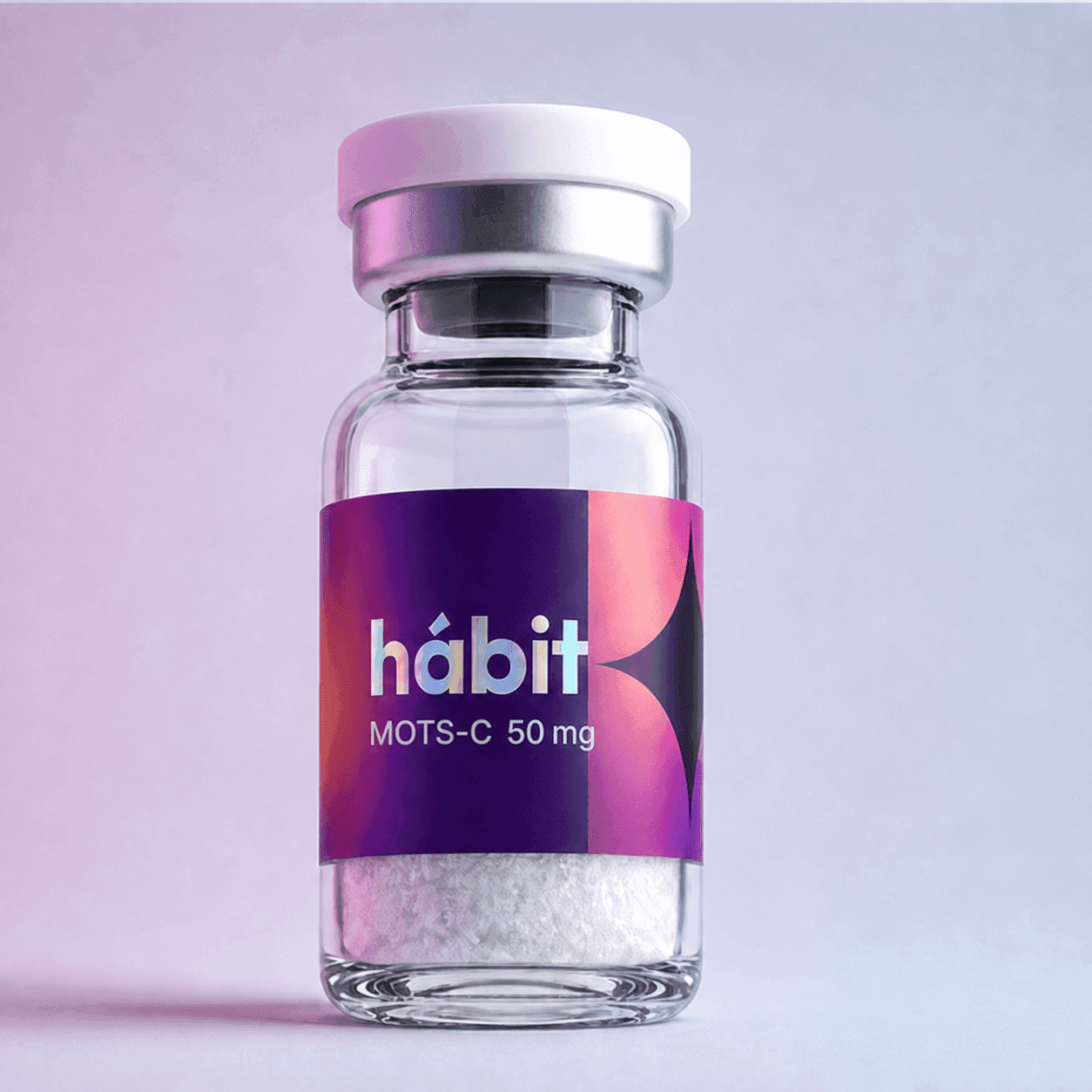
MOTS-c (mitochondrial open reading frame of the 12S rRNA type-c) is one of a small family of mitochondrial-derived peptides. Under metabolic stress it translocates from the mitochondria to the nucleus, where published research has documented effects on AMPK-pathway activation and the folate–methionine one-carbon cycle. It is studied as a regulator of metabolic homeostasis, insulin sensitivity, and exercise-associated adaptation in cell and animal models.
Learn more about the science →Certificate of Analysis+
LC-MS identity, HPLC purity (≥99%), mass spec confirmation, endotoxin by LAL, appearance. Third-party ISO-17025 verified.
View full certificate →Specifications+
Storage & handling+
Lyophilized: −20°C, 24 months. Reconstituted: 2–8°C, use within 30 days. Reconstitute with bacteriostatic water; swirl gently. Protect from light.
We ship in insulated parcels with phase-change cooling and a tamper-evident seal.
FAQs+
What is a mitochondrial-derived peptide?+
A peptide encoded by a short open reading frame within mitochondrial DNA rather than the nuclear genome. MOTS-c is encoded in the 12S rRNA region.
Why is MOTS-c categorized under Metabolic Research?+
Metabolic Research collects compounds studied for metabolic pathways. MOTS-c is mitochondrial in origin, but its published research context is insulin sensitivity and glucose homeostasis, which sits here rather than in Neurological Research.
What pathway is most associated with MOTS-c?+
AMPK activation. Published work also describes nuclear translocation under metabolic stress and effects on the folate–methionine one-carbon cycle.
What's a typical reconstitution concentration?+
Investigator-dependent. A common preparation is 2 mL bacteriostatic water per 50mg vial, yielding 25 mg/mL.
How is MOTS-c quality verified?+
LC-MS identity and HPLC purity on every lot, with mass spec confirmation against the theoretical mass and a third-party ISO-17025 repeat.
Is MOTS-c subscription-eligible?+
Yes. 15% off on a 60-day cycle.
The research behind this compound, cited in full.
Provided for context only. None of the studies cited below evaluate hábit material specifically; they document the published literature on the compound and its mechanism. Research-use claims are not therapeutic claims.
- [01] Lee C. et al. Cell Metab 21 (2015): 443–454.
- [02] Reynolds JC. et al. Nat Commun 12 (2021): 470.
- [03] Kim KH. et al. Cell Metab 28 (2018): 516–524.
- [04] The Mitochondrial-Derived Peptide MOTS-c Promotes Metabolic Homeostasis and Reduces Obesity
Verified buyer notes
Initials only — every quote is verified against an order record. We don’t ghost-write reviews.
“COA matched what we ran in-house. Powder reconstituted clean, no haze. Did exactly what we needed it to.”
“Switched after two bad lots from a previous source. Three orders in, zero issues.”
“Asked support a purity question and got the raw HPLC trace back within the hour. That transparency is why we reorder.”