How it works
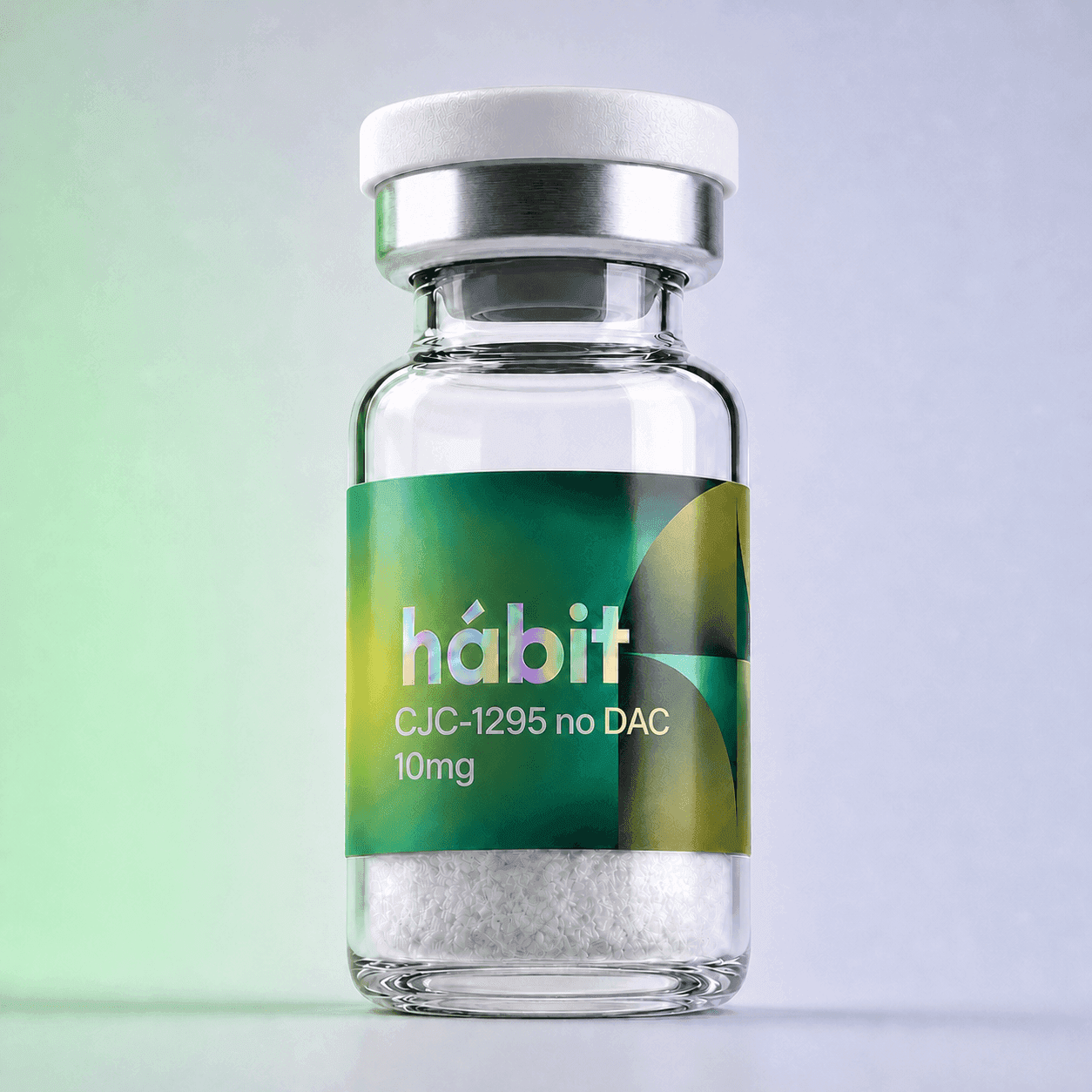
CJC-1295 without DAC — also called Modified GRF (1-29) — is a 29-residue analog of growth-hormone-releasing hormone. Four substitutions relative to native GHRH(1-29) (D-Ala at position 2, Gln at 8, Ala at 15, Leu at 27) protect it from DPP-4 cleavage while preserving GHRH-receptor affinity. It agonizes the GHRH receptor on anterior-pituitary somatotrophs, raising the amplitude of endogenous GH pulses. Unlike the DAC (Drug Affinity Complex) version, which binds albumin and persists for days, the no-DAC form has a short half-life (~30 minutes), so its GH release tracks the body's natural pulsatile rhythm. In research it is most often studied alongside a ghrelin-receptor secretagogue such as ipamorelin, where the two receptor systems produce a larger, more physiological GH pulse than either alone.
Learn more about the science →Certificate of Analysis+
The third-party certificate for this compound's current lot has not been published yet. It will appear here as soon as the laboratory issues it. For status, contact sales@myhabitlabs.com.
Specifications+
Storage & handling+
Lyophilized: −20°C, 24 months. Reconstituted: 2–8°C, use within 30 days. Reconstitute with bacteriostatic water; swirl gently, do not shake. Protect from repeated freeze-thaw.
We ship in insulated parcels with phase-change cooling and a tamper-evident seal.
FAQs+
What does “no DAC” mean?+
DAC (Drug Affinity Complex) is a modification that binds the peptide to albumin, extending its half-life to several days. The no-DAC form — Modified GRF (1-29) — omits that, giving a short (~30 minute) half-life that better mimics the body's natural pulsatile GHRH signalling.
How is CJC-1295 different from ipamorelin?+
CJC-1295 is a GHRH-receptor agonist; ipamorelin acts on the separate ghrelin/GHS receptor. Because they engage distinct pathways, they are frequently studied together for an additive, more physiological GH pulse.
Why the four amino-acid substitutions?+
They protect Modified GRF (1-29) from DPP-4 enzymatic cleavage while preserving GHRH-receptor binding — the change that makes the analog stable enough to study without the DAC linker.
What's a typical reconstitution concentration?+
Investigator-dependent. A common preparation is 2 mL bacteriostatic water per 10mg vial, yielding 5 mg/mL.
How is identity confirmed on the COA?+
By HPLC retention time and UV spectrum against a reference standard, reported alongside HPLC purity and net content per vial by an independent third-party laboratory.
Is CJC-1295 (no DAC) subscription-eligible?+
Yes. 15% off on a 60-day cycle.
The research behind this compound, cited in full.
Provided for context only. None of the studies cited below evaluate hábit material specifically; they document the published literature on the compound and its mechanism. Research-use claims are not therapeutic claims.
- [01] Teichman SL. et al. J Clin Endocrinol Metab 91 (2006): 799–805.
- [02] Sackmann-Sala L. et al. Mol Cell Endocrinol 382 (2014): 220–230.
- [03] Ionescu M. & Frohman LA. J Clin Endocrinol Metab 91 (2006): 4792–4797.
Verified buyer notes
Initials only — every quote is verified against an order record. We don’t ghost-write reviews.
“COA matched what we ran in-house. Powder reconstituted clean, no haze. Did exactly what we needed it to.”
“Switched after two bad lots from a previous source. Three orders in, zero issues.”
“Asked support a purity question and got the raw HPLC trace back within the hour. That transparency is why we reorder.”